
 |


17HS6425-08
Zhong Hua Jiang
3.0V
2.5A
60mm
Zhong Hua Jiang NEMA 42 hybrid stepper motors are considered for industrial positioning systems, large CNC motion axes, automation machinery and other applications requiring a larger mounting frame. Selection should be based on the exact model number, mechanical drawing, phase current, torque-speed curve, load inertia and operating duty cycle.
For buyers comparing a NEMA 42 motor with NEMA 34 or NEMA 23 alternatives, the NEMA designation refers to frame size, not guaranteed output torque. Confirm the motor-and-driver combination against the required running speed, acceleration, load torque and installation space.
Model identification: The model currently documented in the specification tables below is 17HS6425-08, a NEMA 17-series stepper motor, not a NEMA 42 motor. The original model sheets are provided separately as small-frame reference information. Do not use their electrical or mechanical values to specify a NEMA 42 installation.
Request NEMA 42 Motor Specifications & Quote
NEMA 42 generally denotes a large stepper-motor mounting frame of approximately 110 mm. The 1.8° step-angle, two-phase hybrid configuration shown in this product title corresponds to 200 full steps per mechanical revolution; the specific unit must be verified against its approved motor drawing and controller configuration.
A holding-torque figure is measured under stationary excitation and is not the same as available torque at speed. For CNC feed axes, rotating tables and heavy automation equipment, review the torque-speed characteristic at the planned driver voltage and phase current, including acceleration margins and the expected duty cycle.
• Exact NEMA 42 motor model and revision; 2-phase, 1.8° configuration and wiring type
• Mounting flange and bolt pattern; motor length; pilot diameter; shaft diameter, length and optional keyway
• Rated phase current, phase resistance, inductance and suitable stepper driver
• Holding torque and dynamic torque-speed curve measured under specified driver conditions
• Load inertia, transmission ratio, acceleration, deceleration and required travel speed
• Operating temperature, insulation requirements and expected installation environment
• Cable arrangement, connector style, brake or encoder needs and application-specific documentation
Ask for Model-Specific Dimensions and Torque Curve
Check the actual motor mounting-face drawing before preparing a machine plate or ordering couplings. Confirm the pilot, bolt-hole positions, shaft fit, axial clearance and mounting direction. A NEMA size name alone does not establish the shaft geometry or motor body length.
Select a compatible two-phase stepper driver using the motor's phase-current and winding characteristics. Do not treat the winding's rated voltage as a direct recommendation to connect the motor to a fixed-voltage supply; stepper motors are commonly operated with current-controlled drivers.
Microstepping resolution changes command granularity but does not by itself guarantee proportional absolute positioning accuracy. Evaluate torque margin, resonance, motor heating, machine mechanics and feedback requirements with the complete motion system.
Route motor power cables and low-level sensor or encoder signals according to the machine electrical design. Confirm grounding, cable shielding, connector pinouts and permitted cable length using the motor and driver documentation.
Potential applications include industrial CNC axis positioning, machine-tool automation, large rotary indexing equipment, conveyor positioning mechanisms and purpose-built motion-control assemblies. Suitability depends on verified torque at operating speed, motor temperature, shaft loading and mechanical interface.
For distributors, machine builders and OEM procurement teams, a complete request should include quantity, market or project destination, required shaft and flange dimensions, expected torque-speed performance, controller model and any documentation needed for product approval.
Discuss NEMA 42 Motor Supply Requirements
| Frame | NEMA 17 | NEMA 34 | NEMA 42 |
| Nominal mounting frame | Approximately 42 mm | Approximately 86 mm | Approximately 110 mm |
| Typical selection focus | Compact automation | Medium-to-large CNC axes | Large industrial positioning systems |
| Current, torque and body length | Model-specific | Model-specific | Model-specific |
| Mechanical compatibility | Verify drawing | Verify drawing | Verify drawing |
Frame sizes are approximate identification references. Do not interchange motors on the basis of flange width alone; verify mounting drawings and the required torque at operating speed.
Model identification: The following original specification and technical images refer to model 17HS6425-08, a smaller NEMA 17-series motor. They do not define the NEMA 42 motor offered in the title of this page. Contact Zhong Hua Jiang for the correct large-frame motor data sheet.

17HS6425-08 reference motor image; this is not a NEMA 42 product photograph.
| Item | Specifications |
| No.of Phases | 2 |
| Step Angel | 1.8°±5% |
| Rated Voltage | 3.0V |
| Rated Current | 2.5A |
| Resistance | 1.2 ohm±10% AT 20°C |
| Inductance | 2.9 mH±20% AT 1kHz, 1Vrms |
| Holding Torque | Above 0.8 N.m/MIN |
| Detent Torque | Below 3.2 N.cm/Max |
| Rotor Inertia | 102 g.cm² |
| Lead Style | AWG26 UL1007 |
| Insulation Class | CLASS B |
| Dielectric Strength | 500V A.C 1 minute/MINUTE |
| Insulation Resistance | Above 100MΩ/MIN. |
| Allowable Thrust Load | 10N |
| Allowable Radial Load | 21N (Shaft End/ON THE SHAFT END) |
The general-specification table above records holding torque as “Above 0.8 N.m/MIN”, while the electrical table below lists “80 mN.m”. These figures are inconsistent and should be confirmed using a signed model-specific specification before any motor is selected.
| Model No. | Step Angel | Motor Length | Voltage | Current | Resistance | Inductance | Holding Torque | Inertia | Lead Style |
| (°) | (L)mm | V | A | Ω | mH | mN.m | g.cm² | # | |
| 17HS642 5-08 | 1.8 | 60 | 3.0 | 2.5 | 1.2 | 2.9 | 80 | 102 | AWG26 1061 |
The electrical table is retained as published for model 17HS6425-08. Its values must not be reused as NEMA 42 performance data. Actual stepper-driver settings depend on the approved data sheet for the unit purchased.
| Insulation Level | Insulation Voltage | Insulation Resistance |
| Class B | 500V A.C 1 Minute | Above 100 MΩ |
| Class F | 500V A.C 1 Minute | Above 100 MΩ |
Insulation systems are classified by thermal endurance. The reference classification table below lists general insulation grades; it should not be interpreted as a certification of a particular NEMA 42 motor.
| Temperature class of insulation | A Level | E Level | B Level | F Level | H Level |
| Maximum allowable temperature (℃) | 105 | 120 | 130 | 155 | 180 |
| Winding temperature rise limit (K) | 60 | 75 | 80 | 100 | 125 |
| Performance reference temperature (℃) | 80 | 95 | 100 | 120 | 145 |

Original small-frame motor dimension illustration. Request a separate NEMA 42 mechanical drawing.
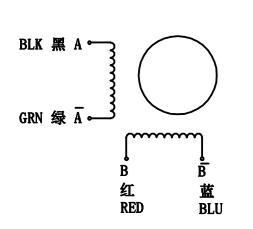
Original wiring diagram; use only with its corresponding motor identification and conductor data.
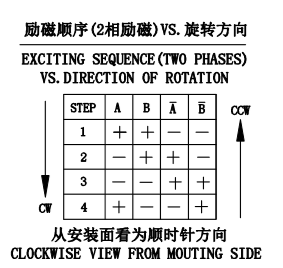
Original excitation-sequence illustration. Confirm motor phases and driver instructions before connection.
| Step Angle Accuracy | ±5% |
| Resistance Accuracy | ±10% |
| Inductance Accuracy | ±20% |
| Temperature Rise | 80°C Max. |
| Ambient Temperature | -20°C~+50°C |
| Insulation Resistance | 100MΩ Min 500V DC |
| Dielectric strength | 500V AC 1 Minute |
| Allowable Radial Load | 21N |
| Allowable Thrust Load | 10N |
The temperature, dielectric, load and accuracy figures above are published with the 17HS6425-08 reference data. The corresponding operating limits for a NEMA 42 motor require confirmation against the correct orderable model.
Request Verified NEMA 42 Technical Documents

Zhong Hua Jiang company profile image.

Zhong Hua Jiang company image.
Huajiang was founded in 2000, initially focusing on CNC engraving spindle motors and later expanding into VFDs, engraving machines and related CNC components. The Zhong Hua Jiang brand was established in 2018 to serve international customers.
The company describes a registered patent related to an air-cooled spindle motor series, patent number 200730184245.5. Buyers seeking stepper motors can discuss application requirements, motor dimensions and supporting product documentation with the sales team.
Machine builders and purchasing teams can contact Zhong Hua Jiang to discuss product fit, application-specific dimensions, quantity requirements and the documentation needed for evaluation. Confirm configuration, pricing, production arrangements and delivery terms through a formal quotation.
 | ||
| Quality Assurance Superior quality performance Strict quality control | Patents and Certifications Several patents for air-cooled spindle motors | Additional Brand Value Brand value highly recognized by the market |
 | ||
| Reasonable Price Direct factory sales Highly cost performance | Full time Service Professional technical support Close and quick customer service | Fast and Reliable Delivery Fast and efficient delivery system Real-time tracking and updates |

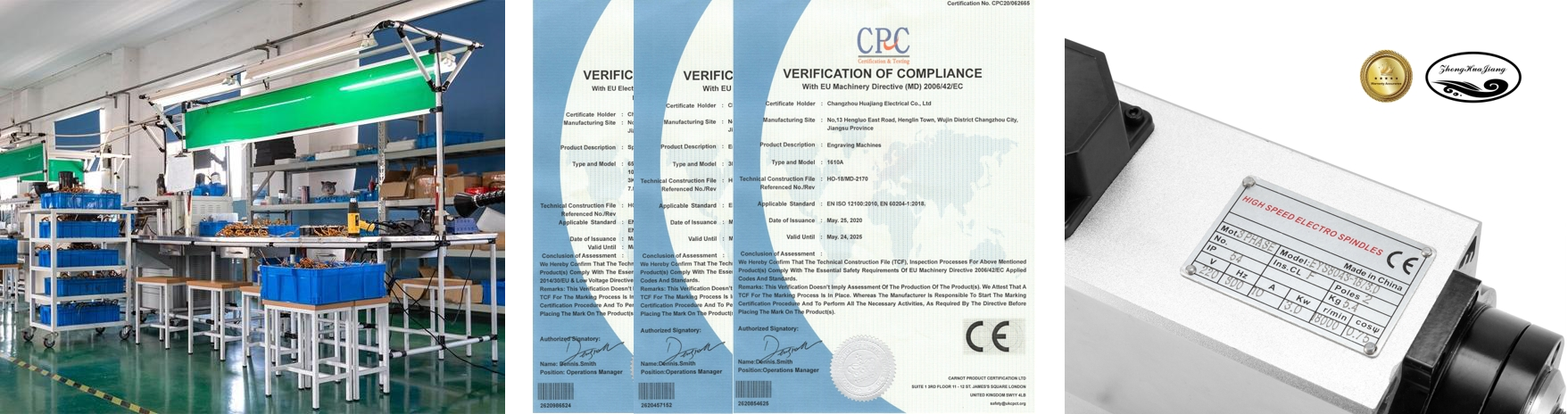
Company product certificate illustration.
When certification or regulatory declarations are required for a project, request documents covering the exact motor model and intended destination market. General company certificates or unrelated CNC component documents do not establish certification for a NEMA 42 motor.
NEMA 42 describes a large motor mounting-frame category, generally around 110 mm. It is a frame designation rather than a guarantee of particular torque, current or shaft dimensions.
No. NEMA 17 motors generally use an approximately 42 mm mounting frame, while NEMA 42 motors use a much larger mounting frame. The 17HS6425-08 reference on this page belongs to the NEMA 17 series.
A 1.8° motor has 200 nominal full steps per mechanical revolution. Actual positioning performance depends on the motor, drive electronics, load and mechanics.
A two-phase hybrid stepper uses two electrical phases and a hybrid rotor/stator construction to produce controlled incremental motion under a suitable stepper driver.
No. Motors with the same frame designation can have different body lengths, winding designs and holding torques. Always compare the exact model and torque-speed curve.
Calculate load torque, acceleration demand, friction, transmission ratio and a practical operating margin. Holding torque alone does not indicate torque available while the axis is moving.
Holding torque is measured under stationary excitation. Running torque changes with speed, driver voltage, winding characteristics and current settings. Check the torque-speed curve for the intended system.
Choose a compatible two-phase driver based on verified motor phase current, winding data, available supply and control interface. Confirm settings against both motor and driver instructions.
Typically a suitable current-controlled stepper drive is required for phase commutation and current limiting. Do not connect an unknown motor directly to a power supply based only on a winding-voltage figure.
It can be considered for larger motion axes when the required running torque, speed, mechanical envelope and driver compatibility match the application. It is not automatically the best choice for every CNC router.
NEMA 42 uses a larger nominal mounting frame. Whether it provides a better solution depends on the exact motors, torque-speed requirements, system mass, space and cost.
They may be candidates for indexing or positioning systems, often with a gearbox, but the torque-speed profile, reflected inertia, duty cycle and backlash requirements must be evaluated.
Verify flange geometry, bolt spacing, pilot diameter, shaft diameter and length, body length, cable exit and the required clearance from an accurate motor drawing.
Compare rotor and reflected load inertia when choosing acceleration and control settings. Excess inertia mismatch may limit acceleration or cause missed steps.
A compatible drive may support microstepping. It improves current-waveform control and command resolution but does not guarantee the same increase in mechanical positioning accuracy.
Not always. Encoder feedback can be useful when lost-step detection or closed-loop motion control is required, depending on the chosen motor and drive configuration.
No. The 17HS6425-08 specifications describe a NEMA 17-series motor. Request a model-specific NEMA 42 data sheet before approval or purchase.
The preserved reference tables contain inconsistent torque figures. Treat them as unverified until the manufacturer provides an approved and consistent specification for the named model.
State the expected ambient range, enclosure conditions, duty cycle and acceptable temperature rise. The motor insulation and thermal limits must match the exact model data sheet.
Provide the required shaft details, flange geometry, cable or connector design, quantity and working conditions. Ask the sales team to confirm which configurations can be supplied.
Request the motor model number, dimension drawing, phase specifications, torque-speed curve, wiring diagram, test or compliance documents if applicable and a formal commercial quotation.
Send the intended machine application, required frame and shaft details, speed and torque needs, drive information, quantity and delivery location through the contact form.


