What Is a CNC Spindle Motor?
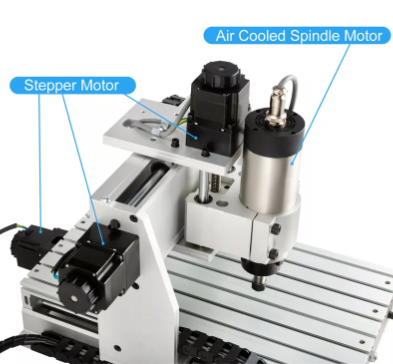
A CNC spindle motor is the high-speed rotating motor that drives the cutting tool on a CNC router, engraving machine, milling machine, or other CNC equipment. It provides the speed, torque, and stability needed to cut, engrave, drill, mill, or polish materials such as wood, aluminum, acrylic, PVC, stone, glass, and light metals.
In simple terms, the CNC spindle motor is the “cutting heart” of the machine. While the CNC controller moves the machine along the X, Y, and Z axes, the spindle rotates the tool at high speed so the material can be processed accurately and efficiently.
Most CNC spindle motors are AC high-speed motors controlled by a VFD, also called a variable frequency drive. Many CNC spindle motors run above 10,000 RPM, and common industrial models can reach 18,000 RPM, 24,000 RPM, or higher depending on the design, power, bearings, and cooling method.
How Does a CNC Spindle Motor Work?
A CNC spindle motor works by converting electrical energy into high-speed mechanical rotation. In a three-phase spindle motor, the stator windings are arranged with a 120-degree phase difference. When three-phase alternating current is applied, the windings create a rotating magnetic field that drives the rotor and spindle shaft.
The spindle speed is mainly controlled by changing the input frequency from the VFD. The synchronous speed can be calculated by the formula n = 60f / p, where n is speed, f is input frequency, and p is the number of pole pairs. By adjusting the frequency and voltage, the VFD allows the spindle motor to accelerate, decelerate, and maintain stable speed during machining.
The rotation direction can also be changed by adjusting the phase sequence of the three-phase input current. This allows the CNC spindle motor to rotate clockwise or counterclockwise according to the machining requirement.
Key Features of CNC Spindle Motors
High speed for cutting, engraving, milling, drilling, and polishing.
Stable rotation for better surface finish and machining accuracy.
Low vibration and low noise when matched with quality bearings and correct installation.
Compact structure with high power density.
Adjustable speed through a CNC VFD.
Fast heat dissipation through air cooling or water cooling.
Long service life when used with proper cooling, clean collets, and correct cutting parameters.
Air-Cooled vs Water-Cooled CNC Spindle Motor
| Type | Advantages | Best For |
| Air-cooled spindle motor | Simple installation, no water pump required, easier maintenance. | Woodworking, advertising signs, general CNC routing, workshops with limited water-cooling setup. |
| Water-cooled spindle motor | Better cooling performance, lower noise, suitable for longer working time. | Long-time engraving, high-speed machining, applications requiring quieter operation. |
Common Applications of CNC Spindle Motors
CNC spindle motors are widely used in woodworking, aluminum processing, stone engraving, glass processing, mold making, PCB drilling, advertising sign production, furniture manufacturing, craft engraving, and light industrial machining. They are especially important in CNC routers because the spindle directly affects cutting quality, tool life, surface finish, and production efficiency.
How to Choose the Right CNC Spindle Motor
To choose the right CNC spindle motor, consider the material, cutting depth, tool diameter, spindle power, speed range, cooling method, collet size, bearing quality, voltage, and VFD compatibility. For light engraving, a lower-power spindle may be enough. For cutting thicker wood, aluminum, or harder materials, a higher-power spindle with stable torque and reliable cooling is usually recommended.
The spindle motor should also match the machine frame and CNC controller. A powerful spindle on a weak machine may cause vibration, poor finish, or reduced accuracy. A suitable spindle should provide enough power while keeping the whole CNC system stable.
FAQ About CNC Spindle Motors
What is the difference between a CNC spindle motor and a normal motor?
A CNC spindle motor is designed for high-speed, precision machining. Compared with a normal motor, it usually has higher RPM, better dynamic balance, lower vibration, precision bearings, and VFD speed control.
How fast does a CNC spindle motor run?
Many CNC spindle motors run from 10,000 RPM to 24,000 RPM. Some high-speed models can run even faster, depending on the motor structure, bearing design, power, and cooling system.
Do CNC spindle motors need a VFD?
Yes, most three-phase CNC spindle motors need a VFD to control speed, start and stop smoothly, change rotation direction, and protect the spindle during operation.
Which is better, air-cooled or water-cooled spindle?
Air-cooled spindles are easier to install and maintain, while water-cooled spindles are quieter and offer better cooling for long working hours. The better choice depends on the machining environment, working time, noise requirement, and maintenance preference.
How can I extend the service life of a CNC spindle motor?
Use the correct VFD settings, ensure stable cooling, avoid overloading, clean the collet and tool holder regularly, use balanced cutting tools, and choose proper feed rate and spindle speed for each material.


 English
 简体中文
简体中文 繁體中文
繁體中文 العربية
 Français
 Русский
 Español
 Português
 Deutsch
 italiano
 日本語
日本語 한국어
한국어 Nederlands
 Tiếng Việt
 ไทย
ไทย Polski
 Türkçe
 አማርኛ
አማርኛ ພາສາລາວ
 ភាសាខ្មែរ
 Bahasa Melayu
 ဗမာစာ
ဗမာစာ தமிழ்
தமிழ் Filipino
 Bahasa Indonesia
 magyar
 Română
 Čeština
 Монгол
 қазақ
қазақ Српски
 हिन्दी
 فارسی
فارسی Kiswahili
 Slovenčina
 Slovenščina
 Norsk
Norsk Svenska
 українська
 Ελληνικά
 Suomi
Suomi Հայերեն
 עברית
עברית Latine
 Dansk
Dansk اردو
اردو Shqip
Shqip বাংলা
বাংলা Hrvatski
 Afrikaans
 Gaeilge
 Eesti keel
 Māori
Māori සිංහල
සිංහල नेपाली
 Oʻzbekcha
 latviešu
 অসমীয়া
 Aymara
 Azərbaycan dili
 Bamanankan
 Euskara
 Беларуская мова
 भोजपुरी
 Bosanski
 Български
 Català
 Cebuano
 Corsu
Corsu ދިވެހި
 डोग्रिड ने दी
 Esperanto
 Eʋegbe
 Frysk
Frysk Galego
 ქართული
 guarani
 ગુજરાતી
 Kreyòl ayisyen
 Hausa
Hausa ʻŌlelo Hawaiʻi
 Hmoob
Hmoob íslenska
 Igbo
Igbo Ilocano
 Basa Jawa
 ಕನ್ನಡ
ಕನ್ನಡ Kinyarwanda
 गोंगेन हें नांव
 Krio we dɛn kɔl Krio
 Kurdî
Kurdî Kurdî
Kurdî Кыргызча
 Lingala
 Lietuvių
 Oluganda
 Lëtzebuergesch
 Македонски
 मैथिली
 Malagasy
 മലയാളം
 Malti
Malti मराठी
मराठी ꯃꯦꯇꯥꯏ (ꯃꯅꯤꯄꯨꯔꯤ) ꯴.
 Mizo tawng
 Chichewa
 ଓଡ଼ିଆ
ଓଡ଼ିଆ Afaan Oromoo
 پښتو
پښتو ਪੰਜਾਬੀ
 Runasimi
 Gagana Samoa
 संस्कृत
 Gaelo Albannach
 Sepeti
 Sesotho
 chiShona
 سنڌي
سنڌي Soomaali
 Basa Sunda
 Wikang Tagalog
 Тоҷикӣ
 Татарча
 తెలుగు
 ትግንያውያን
 Xitsonga
 Türkmençe
 संस्कृत
 ئۇيغۇرچە
 Cymraeg
 isiXhosa
 ייִדיש
 Yorùbá
 isiZulu


