You are here:Home » News » CNC Spindle Motor Selection Guide: Power, RPM, Torque, And Cooling Explained
CNC Spindle Motor Selection Guide: Power, RPM, Torque, And Cooling Explained
Views: 0 Author: Site Editor Publish Time: 2026-08-18 Origin: Site
You need to focus on choosing the right CNC Spindle Motor for your project because it drives the cutting, carving, or engraving process in CNC machine tools. The correct selection impacts the finish quality and efficiency in applications like woodworking, furniture production, and aerospace components. Key factors include power, RPM, torque, and cooling. Zhong Hua Jiang leads the industry with patented air-cooled and water-cooled CNC Spindle Motors that deliver high precision and suit many types of CNC spindles.
What Is a CNC Spindle Motor?
Core Function and Importance
A cnc spindle motor is the heart of your CNC machine. It drives the cutting tool, allowing you to mill, drill, route, grind, or engrave with precision. You rely on the spindle motor to convert electrical energy into mechanical rotation, which powers the tool at high speeds. This process ensures you achieve smooth finishes and accurate cuts, even when working with tough materials.
Here is a quick overview of the main components and functions of a cnc spindle motor:
Component/Function
Description
Electric Motor
Integrates a high-speed shaft with a tool-holding mechanism, designed for high lateral and axial loads.
Energy Conversion
Converts electrical energy from a variable frequency drive (VFD) into mechanical rotation for precise machining.
RPM Maintenance
Maintains a set RPM under load, using feedback systems to prevent slowing down during cutting.
VFD Role
Controls frequency and voltage to adjust RPM for different bit sizes.
You use the cnc spindle motor for a wide range of tasks:
Milling complex shapes in aerospace and automotive parts.
Drilling precise holes in circuit boards and metal components.
Routing detailed patterns in wood, plastic, and composites.
Grinding surfaces for tool and die making.
Engraving intricate designs on jewelry and signage.
A high-quality spindle motor delivers strong torque at various speeds. It maintains surface finish and tool integrity, even during long machining sessions. The motor withstands heat and friction, which helps you achieve consistent results.
Why Selection Matters
Choosing the right cnc spindle motor directly impacts your machining accuracy and productivity. When you select a high-quality spindle, you gain:
Factor
Impact on Machining Accuracy and Productivity
High-Quality Spindles
Essential for precision-critical operations, such as aerospace and medical technology.
Motor Design
High-frequency capabilities influence spindle performance and machining results.
Bearing Quality
Reduces friction and wear, improving precision and maintaining tight tolerances.
Clamping System
Reduces runout and vibrations, enhancing machining quality.
Cooling System
Maintains stable temperatures for better surface finishes and tighter tolerances.
Speed and Torque
Enables faster machining and handles heavy-duty cutting loads effectively.
You want a spindle motor that matches your application. For example, woodworking requires different speeds and torque than metal cutting. Zhong Hua Jiang stands out as a trusted manufacturer with over two decades of experience. The company’s patented air-cooled and water-cooled spindle motors meet strict quality standards and serve customers worldwide. When you choose a spindle motor from Zhong Hua Jiang, you invest in reliability, innovation, and proven performance.
CNC Spindle Motor Power
Power Ratings Explained
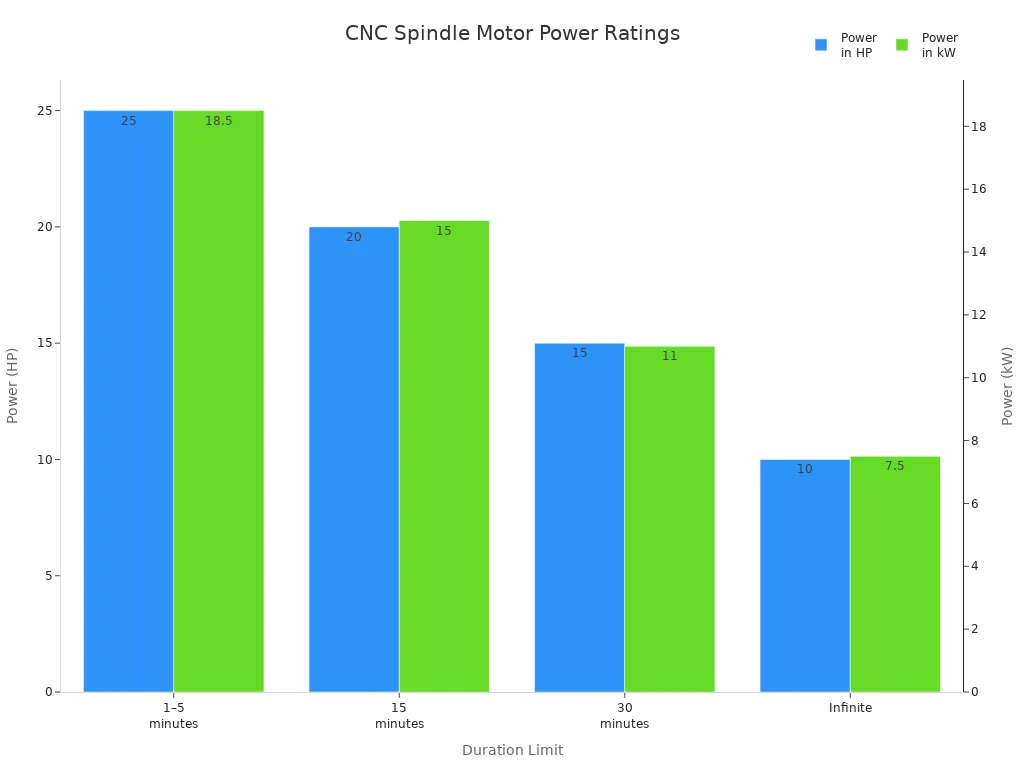
When you select a cnc spindle motor, you must understand how manufacturers rate power. Most spindle motors use kilowatts (kW) or horsepower (HP) as standard units. One kilowatt equals about 1.34 horsepower. Manufacturers often list several ratings based on how long the motor can sustain a certain power level. You see terms like "peak," "short-term," "30-minute," and "continuous" ratings. These ratings help you match the motor to your machining needs.
Rating Type
Typical Power
Duration Limit
Application
Peak / Minute
25 HP (18.5 kW)
1–5 minutes
Heavy roughing, peck drilling
Short-term
20 HP (15 kW)
15 minutes
Roughing passes, slotting
30-minute
15 HP (11 kW)
30 minutes
General machining, turning
Continuous
10 HP (7.5 kW)
Infinite
Finishing, light cuts
Calculating Power Needs
You must match the power of your cnc spindle motor to your application. If you work with soft materials or perform light engraving, a lower power motor works well. For heavy-duty cutting or machining metals, you need higher power. Power directly affects torque, which determines how efficiently you remove material. Higher power also means you can maintain speed under load, which improves surface finish and reduces tool wear.
Zhong Hua Jiang offers a wide range of spindle motors, including popular models like the 2.2 kW water-cooled and 3 kW air-cooled options. These models provide reliable performance for many CNC tasks. When you calculate your power needs, consider the type of material, the size of your cutting tool, and the desired rpm.
Aspect
Impact of Spindle Motor Power
Torque
Higher power increases torque for better material removal rates.
Cutting Performance
More efficient cutting for harder metals and specialized jobs.
Speed
High-speed drives maintain precision and feedback.
Quality of Machining
Enhanced ability to produce quality parts in less time.
Power for Different Materials
The material you machine determines the ideal power range for your cnc spindle motor. For woodworking and plastics, you usually need 3 kW to 5 kW. Aluminum and light metals require 5 kW to 10 kW. Steel and hard metals often need 10 kW or more. Matching the right power ensures you achieve clean cuts and efficient production.
Material Type
Recommended Power Level
RPM Range
Woodworking & Plastics
3 kW - 5 kW
18,000 - 24,000
Aluminum & Light Metals
5 kW - 10 kW
10,000 - 20,000
Steel & Hard Metals
10 kW+
5,000 - 10,000
RPM and Cutting Quality
What Is RPM?
RPM stands for revolutions per minute. It measures how many times the spindle rotates in one minute. When you use a cnc spindle motor, you control the rpm to match your cutting needs. Higher rpm means the tool spins faster, which can improve surface finish and reduce cutting time. Lower rpm gives you more control and helps when you need extra torque for tough materials. You should always check the recommended rpm for your cutting tool and material to get the best results.
High vs. Low RPM Uses
You need to understand when to use high or low rpm. High rpm works well for small tools and soft materials. It gives you a smooth finish and lets you cut quickly. Low rpm is better for large tools or hard materials. It provides more torque and prevents tool breakage. The table below shows the main advantages and disadvantages of each approach:
Advantages
Disadvantages
Exceptional precision
Lower torque at low speeds
High RPM capabilities
Potential for rapid wear on bearings
Matching RPM to Tools and Materials
You must match rpm to your cutting tool and material for safe and efficient machining. Each material has an ideal cutting speed and feed rate. You can use the formula: RPM = (Cutting Speed × 1000) / (π × Tool Diameter) This formula helps you set the correct rpm for your cnc spindle motor. The table below gives you starting points for common materials:
Material
Cutting Speed (m/min)
Feed per Tooth (mm)
Notes
Aluminum (6061)
200-400
0.05-0.15
Higher speeds possible with proper chip evacuation
Mild Steel (1018)
120-250
0.05-0.12
Very forgiving, good for learning
Stainless Steel (304)
80-150
0.03-0.08
Work hardens if feed too light
Titanium (Grade 5)
40-80
0.02-0.06
Low speeds, high coolant volume
You should always adjust rpm based on tool diameter and material hardness. This practice extends tool life and improves your finished product. When you select the right rpm, you also make the most of your spindle motor's power and efficiency.
Torque in CNC Spindle Motors
Torque vs. RPM
You must understand how torque and rpm interact in a cnc spindle motor. Torque measures the twisting force that turns the cutting tool. At lower rpm, torque stays at its maximum output, which gives you strong cutting force for tough materials. As rpm increases, torque remains steady until about 6000 to 9000 rpm, depending on the load. Horsepower rises with rpm, so you get more power at higher speed. This relationship helps you optimize machining by choosing the right speed for your material and tool. If you want to cut steel or other hard metals, you need high torque at low speed. For softer materials, you can use higher rpm and rely on increased power.
RPM Range
Torque Output
Power Output
Machining Application
Low (0-6000)
Maximum
Moderate
Heavy-duty, tough materials
Mid (6000-9000)
Stable
Increasing
General machining
High (>9000)
Drops
High
Fine finishing, soft materials
Torque for Heavy-Duty Work
When you work with heavy-duty materials, torque becomes critical. Cutting torque affects tool life and machining quality. You must select a cnc spindle motor with enough torque to handle deep cuts and tough metals. Consider these factors for heavy-duty applications:
Cutting torque impacts tool life, so optimal ranges reduce stress and wear.
Choose the right machine for your workload, since different models offer varying torque capabilities.
Tool geometry and coating change the required cutting torque, so select tools based on material and cutting parameters.
Adjust feed rate, spindle speed, and depth of cut to control cutting torque.
Monitor cutting torque in real time with modern CNC machines for early issue detection.
If you want to maximize efficiency, select a spindle motor from Zhong Hua Jiang with robust torque specifications. This choice ensures you get reliable performance for demanding jobs.
Balancing Torque and Speed
Balancing torque and speed is essential for optimal machining. You need to use a torque chart to set cutting parameters. Adjust the width of cut before depth to keep material removal efficient. Balance feed rates and rpm to get the best results:
Reduce feed rate or rpm if spindle load is too high.
Increase feed rate if your machine is underloaded.
Listen for changes in sound and watch chip formation to spot needed adjustments.
You must find the right balance between torque and speed for each job. If you use too much speed, you risk tool wear and poor surface finish. If you rely only on torque, you may slow production. The best approach is to match your spindle motor’s torque and speed to your material and tool. This practice gives you consistent results and extends tool life.
Cooling Methods for Spindle Motors
Air-Cooled vs. Water-Cooled
When you select a cooling method for your cnc spindle motor, you must weigh the differences between air-cooled and water-cooled designs. Air-cooled spindle motors use fans to move air across the motor body, while water-cooled models circulate coolant through internal channels. Zhong Hua Jiang offers both patented air-cooled and quiet water-cooled spindle motors, giving you options for any workshop.
Here is a quick comparison of efficiency and maintenance:
Factor
Air Cooling
Water Cooling
Average Spindle Life
8,000-12,000 hours
12,000-18,000 hours
Bearing Longevity
Moderate
Excellent
Thermal Stress
Higher
Lower
Replacement Interval
3-5 years (moderate use)
5-8 years (moderate use)
Maintenance Checklist:
Air-cooled: Clean fins monthly, replace fan every 2-3 years, inspect bearings annually. Annual cost: $80-$150.
Water-cooled: Change coolant every 3-6 months, inspect pump quarterly, replace hoses every 2-3 years, replace pump every 3-5 years, inspect bearings annually. Annual cost: $150-$300.
Choosing the Right Cooling
You should consider several factors when choosing a cooling method for your spindle motor. Think about your material type, power needs, and the duration of your machining tasks. Water-cooled spindle motors excel in long, continuous operations and high-precision work because they keep temperatures stable. Air-cooled models work well for short jobs, lighter materials, or environments where water systems are not practical.
Factor
Considerations
Material Type
Wood, metal, composite
Power and Torque
Power ratings (0.8KW–9KW), torque requirements
Cooling Method
Air-cooled or water-cooled
Budget
Initial cost vs. long-term investment
CNC Compatibility
Mounting, electrical, and control requirements
You also need to think about your workshop environment. High ambient temperatures can reduce air-cooling efficiency, while water-cooled systems may face freezing risks in cold climates. If you want consistent performance and longer spindle life, water cooling is often the best choice for demanding applications. For simple setups or hobby use, air cooling provides reliable results with less maintenance.
Matching Spindle Motor to Application
Wood, Plastics, and Light Materials
You need to select the right spindle motor for woodworking, plastics, and other light materials to achieve clean cuts and high productivity. For these materials, air-cooled spindle motors offer reliable performance and easy maintenance. You can use them for woodworking, plywood cutting, plastics, acrylic sheets, and even soft aluminum milling. These motors also suit hobby CNC builds and prototyping.
Here is a quick comparison of common spindle motor types for light materials:
Motor Type
Power Range
Applications
CNC Router Spindle
0.8–2.2 kW
Wood, Plastics, Aluminum, Steel
Katsu Router
N/A
Woodworking, Plastics, Soft Aluminum
Air-Cooled Spindle
N/A
Woodworking, Plastics, Light Metals
You should choose a spindle motor in the 0.8 kW to 2.2 kW range for most light material applications. This power range gives you enough speed and control for detailed work without excessive energy use.
Metals and Heavy-Duty Machining
When you work with metals or require heavy-duty machining, you need a spindle motor with higher power and advanced cooling. Steel and hard metals demand water-cooled, high-torque motors. These motors handle deep cuts and maintain precision during long machining sessions.
Material Type
Recommended Motor Type
Specifications
Steel & Hard Metals
Water-cooled, high torque
Power: 10 kW+, RPM: 5,000 - 10,000, Cooling: Water-cooled, High torque for deep cuts and precision.
You should select a water-cooled spindle motor with at least 10 kW of power for steel and other hard metals. This setup ensures stable temperatures, reduces thermal stress, and extends spindle life. You also gain the torque needed for demanding cuts and complex geometries.
Hobbyist vs. Industrial Use
Your application type determines the ideal spindle motor specifications. Hobbyists often use lower power motors with basic cooling, while industrial users require advanced systems for higher productivity and durability.
Application Type
Power Range
RPM Range
Cooling Mechanisms
Torque Characteristics
Hobbyist
1.5kW to 3kW
8,000 to 12,000
Basic cooling
Lower torque for softer materials
Industrial
5kW to 10kW
Up to 24,000
Advanced cooling systems
Higher torque for tougher materials
If you build prototypes or work on small projects, a 1.5 kW to 3 kW spindle motor will meet your needs. For production environments or machining metals, you should choose a 5 kW to 10 kW motor with advanced cooling and high torque.
Zhong Hua Jiang supports both hobbyists and industrial users. You can request OEM or ODM customization, including custom logos and specifications. Every cnc spindle motor from Zhong Hua Jiang comes with CE and ISO 9001 certifications, ensuring quality and safety for your application.
Selection Tips and Common Mistakes
Key Questions to Ask
When you select a cnc spindle motor, you need to ask the right questions to ensure you get the best fit for your application. Consider these points:
What tooling options are compatible with the spindle? Large diameter tools require slower speeds and higher torque, while smaller tools benefit from higher spindle speeds for smooth finishes.
Do you need an automatic tool change (ATC) spindle for your current operations? Think about future upgrades and whether ATC integration will improve workflow.
Will your spindle support the materials you plan to machine? Wood, aluminum, and plastics each demand different power and RPM profiles.
Is your workspace equipped with the correct power supply and controller compatibility?
What collet size do you need for your tools? Standard ER-11 fits most small tools, but ER-20 is better for larger end mills.
Pitfalls to Avoid
You can avoid costly mistakes by staying aware of common pitfalls:
Choosing based solely on price.
Ignoring application requirements.
Overlooking bearing quality.
Failing to evaluate supplier capabilities.
Neglecting cooling system design.
Ignoring after-sales support.
Selecting unreliable suppliers without export experience.
To prevent these errors, consider total ownership costs, understand your specific needs, and choose a supplier with proven reliability. This approach improves performance and reduces long-term expenses.
Quick Comparison Table
The table below highlights key differences between popular spindle motor types:
Motor Type
Power Characteristics
RPM Range
Torque Characteristics
Cooling Methods
Universal Motors
High power at high RPMs, low torque at low RPMs
High RPMs
Torque drops at lower speeds
Air-cooled
Variable Frequency Drives
Best at high RPMs, lower efficiency at low RPMs
High RPMs
Lower power-to-weight ratio
Water cooling
DC Brushless Motors
Flatter power curve, high torque from 4,000 to 22,000 RPM
4,000 - 22,000 RPM
High power-to-weight ratio
Air-cooled or water-cooled
You need to focus on four main criteria when selecting a cnc spindle motor: power, RPM, torque, and cooling. The table below shows how each factor impacts machining outcomes:
Selection Criteria
Impact on CNC Machining Outcomes
Power Rating
Essential for cutting denser materials and boosting performance.
Speed Range
Determines precision and suitability for different materials.
Cooling Type
Water-cooled spindles excel in demanding operations.
Torque
Maintains speed under load for challenging cuts.
RPM
Influences cutting speed and surface finish.
Matching spindle specs to your application improves energy efficiency, lowers maintenance costs, and ensures stable performance. Use this quick checklist:
Confirm material type and required power.
Choose the right cooling method.
Check torque and RPM for your tools.
Zhong Hua Jiang offers certified, customizable solutions and expert support. Review the FAQ or contact their team for technical advice.
FAQ
How do you determine the right spindle motor power for your CNC project?
You should match spindle motor power to your material and tool size. For wood and plastics, 2.2 kW works well. For metals, choose 5 kW or higher. Always check your application requirements.
Can you use a spindle motor for both wood and metal?
You can use a spindle motor for both materials if it meets the power and torque requirements. Select the correct RPM and cooling method for each material. Always check compatibility with your CNC machine.
What certifications should you look for in a spindle motor?
Look for CE and ISO 9001 certifications. These ensure safety, quality, and reliability. Zhong Hua Jiang spindle motors meet these standard.
Join us as an exclusive distributor of CNC Router Machines and CNC Spindle Motors. As a professional manufacturer, we provide high-performance machines, attractive profit margins, technical training, and full marketing support. Build a strong partnership with us and expand your market with confidence.


 English
 简体中文
简体中文 繁體中文
繁體中文 العربية
 Français
 Русский
 Español
 Português
 Deutsch
 italiano
 日本語
日本語 한국어
한국어 Nederlands
 Tiếng Việt
 ไทย
ไทย Polski
 Türkçe
 አማርኛ
አማርኛ ພາສາລາວ
 ភាសាខ្មែរ
 Bahasa Melayu
 ဗမာစာ
ဗမာစာ தமிழ்
தமிழ் Filipino
 Bahasa Indonesia
 magyar
 Română
 Čeština
 Монгол
 қазақ
қазақ Српски
 हिन्दी
 فارسی
فارسی Kiswahili
 Slovenčina
 Slovenščina
 Norsk
Norsk Svenska
 українська
 Ελληνικά
 Suomi
Suomi Հայերեն
 עברית
עברית Latine
 Dansk
Dansk اردو
اردو Shqip
Shqip বাংলা
বাংলা Hrvatski
 Afrikaans
 Gaeilge
 Eesti keel
 Māori
Māori සිංහල
සිංහල नेपाली
 Oʻzbekcha
 latviešu
 অসমীয়া
 Aymara
 Azərbaycan dili
 Bamanankan
 Euskara
 Беларуская мова
 भोजपुरी
 Bosanski
 Български
 Català
 Cebuano
 Corsu
Corsu ދިވެހި
 डोग्रिड ने दी
 Esperanto
 Eʋegbe
 Frysk
Frysk Galego
 ქართული
 guarani
 ગુજરાતી
 Kreyòl ayisyen
 Hausa
Hausa ʻŌlelo Hawaiʻi
 Hmoob
Hmoob íslenska
 Igbo
Igbo Ilocano
 Basa Jawa
 ಕನ್ನಡ
ಕನ್ನಡ Kinyarwanda
 गोंगेन हें नांव
 Krio we dɛn kɔl Krio
 Kurdî
Kurdî Kurdî
Kurdî Кыргызча
 Lingala
 Lietuvių
 Oluganda
 Lëtzebuergesch
 Македонски
 मैथिली
 Malagasy
 മലയാളം
 Malti
Malti मराठी
मराठी ꯃꯦꯇꯥꯏ (ꯃꯅꯤꯄꯨꯔꯤ) ꯴.
 Mizo tawng
 Chichewa
 ଓଡ଼ିଆ
ଓଡ଼ିଆ Afaan Oromoo
 پښتو
پښتو ਪੰਜਾਬੀ
 Runasimi
 Gagana Samoa
 संस्कृत
 Gaelo Albannach
 Sepeti
 Sesotho
 chiShona
 سنڌي
سنڌي Soomaali
 Basa Sunda
 Wikang Tagalog
 Тоҷикӣ
 Татарча
 తెలుగు
 ትግንያውያን
 Xitsonga
 Türkmençe
 संस्कृत
 ئۇيغۇرچە
 Cymraeg
 isiXhosa
 ייִדיש
 Yorùbá
 isiZulu